Fat FIRE in Australia: What It Takes and How to Model It

Fat FIRE means reaching financial independence and retiring early while keeping a spending level well above average, instead of a frugal one. In Australia the target is rarely just “a big number”. It is a number split across super you cannot touch until preservation age, assets outside super that must fund the gap, property, tax and, for many families, children. This guide shows how to build that number step by step.
TL;DR
- Fat FIRE is early retirement on a generous budget. Lean FIRE sits at the frugal end, and Barista FIRE mixes part-time work with investing.
- Your target comes from your annual spending, divided by a withdrawal rate you can defend, then adjusted for tax, inflation and where the money sits.
- For anyone born from 1 July 1964, preservation age is 60, so retiring at 45 or 50 means funding a bridge from non-super assets.
- Kids, childcare, property and the Age Pension asset test all move the target, so model them as scenarios side by side, not as one fixed figure.
Table of Contents
- What Fat FIRE means, and how it differs from other FIRE styles
- How much do you need? A worked way to estimate your number
- The Australian catch: super preservation age and the bridge years
- Sketching a bridge plan
- Property and mortgages in a Fat FIRE plan
- Fat FIRE with kids
- Perspective: why we model Fat FIRE in scenarios
- A step-by-step process to test your own plan
- Try it on your own numbers
- FAQ
- Sources
What Fat FIRE means, and how it differs from other FIRE styles
FIRE stands for Financial Independence, Retire Early. The idea is to build enough invested wealth that your portfolio, not a salary, pays for your life. The flavours differ mainly in how much you spend once work stops:
| Style | Spending in retirement | Typical approach |
|---|---|---|
| Lean FIRE | Modest, tightly budgeted | Low costs, earlier exit, smaller portfolio |
| Regular FIRE | Comfortable, near average | Balanced saving and spending |
| Fat FIRE | Above average, with room for travel, private schooling, a bigger home | High income, high savings rate, larger portfolio |
| Barista FIRE | Part covered by part-time work | Portfolio plus a lighter job |
The exact line between regular and Fat is personal. Some people call it Fat once spending passes a six-figure household budget. Others define it by a multiple of average expenses. What matters is that you pick your own annual figure, written in today’s dollars, and build from it. A Fat FIRE target of $150,000 a year is a very different project from $90,000.
Overseas FIRE content often assumes a single retirement account you can draw from at any age. Australia is different. Super is tax-advantaged but preserved, the Age Pension is means-tested, and the family home is treated in its own way. That is why copying a US Fat FIRE number does not work here.
How much do you need? A worked way to estimate your number

The basic arithmetic is simple. Annual spending divided by your withdrawal rate gives the portfolio size.
These are illustrations, not forecasts:
- Spending of $120,000 a year at a 4% withdrawal rate needs $3,000,000.
- The same spending at 3.5% needs about $3,430,000.
- Spending of $200,000 a year at 3.5% needs about $5,710,000.
A lower rate buys safety. People retiring in their 40s need money to last 45 or 50 years, not 30, and one Australian retiree story notes that knowing your numbers matters and the 4% rule can be too simplistic for young early retirees facing many future variables. So treat 4% as a starting line, then stress it.
Before you divide, tighten the spending figure:
- Separate fixed from flexible costs. Housing, insurance, health cover and rates are fixed. Travel, dining and hobbies flex in a bad market year.
- Work in today’s dollars. Then use a real return (return after inflation) so you are not mixing nominal and real figures.
- Add tax. Spending is after tax, so the portfolio must produce more before tax. How much more depends on the account type, which is the next big issue.
- Add a buffer for big irregular costs: cars, renovations, medical, gifting to children.
If you want a structured walk-through, our guide to calculating your FIRE number in Australia covers the method in more detail.
The Australian catch: super preservation age and the bridge years
This is where most Fat FIRE plans in Australia succeed or fail. Super is often the biggest pool of money a high earner has, yet you generally cannot use it when you stop work at 45.
The ATO says preserved super can generally be accessed at preservation age after retirement, at 65 even if you are still working, or under another condition of release. For anyone born from 1 July 1964, preservation age is 60. Early access is limited to specific circumstances such as medical, compassionate, hardship or incapacity grounds, and taking super without meeting a condition of release is illegal. Early retirement alone is not a condition of release. MoneySmart makes the same point: super is not automatically available just because you retire.
So a person who stops work at 45 has a 15-year bridge. At $120,000 a year in today’s dollars, that is $1,800,000 of spending before any investment growth or tax. That money has to sit outside super: shares and ETFs, an investment property, cash, an offset account, or a business.
The practical consequence is that you effectively build two portfolios:
- A bridge pool outside super, sized to fund spending from your last day of work to preservation age.
- A super pool, left to compound until you can access it, sized to fund the rest of your life.
Contributions are the lever that links them. Every dollar you put into super is locked away but taxed lightly; every dollar kept outside is flexible but taxed at your marginal rate on income and gains. The right split is a modelling question, not a rule of thumb. Our pages on super preservation age and on whether you can access super at 55 explain the access rules in plain terms, and conditions of release covers what evidence is needed.
Why account type matters for tax
The ATO notes that retirement withdrawals can be taken as a lump sum, an income stream or a combination, and that tax depends on your age, the payment type and whether the source is taxed or untaxed. Super benefits may be tax-free from 60 in relevant cases. Money in your own name is different: dividends are taxable, and selling ETFs or property triggers capital gains tax. A model that treats $4,000,000 as one pot will mislead you. Model each account, with its own tax, and sequence the drawdown.

Sketching a bridge plan
Here is the shape of a typical Fat FIRE bridge, with invented round numbers to show the logic:
| Stage | Ages | Funded by | Key question |
|---|---|---|---|
| Accumulation | 30 to 45 | Salary, salary sacrifice, investing | How much goes to super versus outside? |
| Bridge | 45 to 60 | ETFs, property income, cash buffer | Is the pool large enough after tax and downturns? |
| Super access | 60 onward | Super pension, tax-free in relevant cases | Does super now carry most spending? |
| Age Pension window | 67 onward | Possible part pension | Do the asset and income tests apply? |
Two risks dominate the bridge. The first is sequence risk: a market fall in your first few years of retirement hurts far more than the same fall later. The second is the cliff at the end, where the bridge pool runs dry just before super opens. Stress-test both by running the plan with lower returns, higher inflation and a poor first three years, then compare the outcomes side by side.
Property and mortgages in a Fat FIRE plan
Most Australian wealth sits in property, so a Fat FIRE plan has to place it somewhere. Ask three questions:
- Is the family home part of the plan or outside it? Your home is not an income-producing asset. If you want to fund life from a portfolio, the home is a cost, not a funding source, unless you plan to downsize and release equity.
- Does an investment property earn its place? Compare net rent after rates, insurance, maintenance and interest with what the same capital would earn in diversified investments, after tax. Also model capital gains tax on sale.
- Should the mortgage be gone before you stop work? A paid-off home cuts your spending target sharply. An offset account can reduce interest while keeping cash accessible for the bridge. The choice is a trade-off between interest saved and money available, which is why it is worth modelling rather than guessing.
If you plan to extend or renovate before you retire, factor in approvals and costs early. For Queensland readers, this overview of home extension planning lists what to check first, which helps you put a realistic number in the plan instead of a placeholder.
Does the Age Pension matter for Fat FIRE?
For many Fat FIRE households, the answer is “little”, but it still deserves a line in your model. Services Australia says Age Pension asset assessments depend on asset values, homeownership and relationship status, with full-pension limits of $333,000 for a single homeowner and $499,000 for a homeowner couple. A multi-million portfolio will sit well above those limits, so you should not count on a pension at 67. A cautious plan treats any pension as an upside, not a foundation. If your wealth later falls, perhaps after big gifts or a long retirement, the pension could become a safety net, so see our explainer on the Age Pension assets test thresholds and how the family home is treated.
Fat FIRE with kids
Children change both sides of the equation: spending rises, and the time you need to stay independent stretches, because kids can still depend on you into their twenties.
The Commonwealth Superannuation Corporation makes the point that retirement income needs are not one-size-fits-all, and supporting dependents, travel and medical needs can change how much income someone needs. For a family, build the cost lines one by one:
- Childcare while you still work. Services Australia says that from 5 January 2026, eligible families can receive at least 3 days of subsidised child care a week, regardless of how much time they spend in work or study. Whether your household qualifies, and how much subsidy applies, depends on your income, so check the official calculators for your own figures.
- Schooling. Decide early whether you assume public, Catholic or independent school, since the gap over 13 years is large. Put the figure in as its own line so you can switch it on and off.
- Housing size. A family home near good schools often costs more to hold than a small place for two. Decide whether you will downsize once the kids leave.
- University, first car, first home help. Many Fat FIRE parents plan some support. Model it as a defined sum in a defined year.
- Health cover and extra activities. These grow as children do.
A useful trick is to run two versions of the plan: one where you retire while the kids are young, and one where you retire when the youngest finishes school. Seeing both side by side shows what each extra working year buys you. Often an additional three to five years of high income, with contributions into both super and a bridge pool, lowers risk more than any investment tweak.
If hardship hits during the working years, Services Australia notes that temporary financial hardship may qualify families for an additional child care subsidy after events such as job loss or business failure. That is a help for the working phase, not a planning assumption.
Perspective: why we model Fat FIRE in scenarios
Most Fat FIRE plans we see fail quietly, not loudly. The headline number looks right, then a spreadsheet hides the fact that half of it is locked in super for fifteen years, or that a rental sale triggers a tax bill nobody budgeted for.
We built AeroWealth so that super, an investment property, ETFs, a mortgage and ongoing contributions sit in one plan under Australian rules. You can compare scenarios side by side, for example retiring at 45 versus 50, or paying down the mortgage versus investing, and see the effect on retirement age, income and net worth.
Our bridge mode is designed for exactly this problem: funding the years before preservation age. Stress tests then let you push on returns, inflation and spending to see where a plan breaks, so you decide with eyes open instead of hoping a single projection holds.
Aerowealth Team
A step-by-step process to test your own plan
- Write your target spending in today’s dollars, split into fixed and flexible.
- List every account with its type: super, ETFs, property, cash, offset. Include the mortgage balance and rate.
- Choose a retirement age and compute the bridge length to your preservation age.
- Size the bridge pool for those years after tax, then size the super pool for the rest.
- Set conservative assumptions: a lower real return, higher inflation, a weak first few years.
- Add life events: kids’ schooling, a home upgrade, a downsize, a property sale with capital gains tax.
- Compare at least three scenarios side by side, and change one variable at a time.
- Revisit yearly. Fat FIRE plans are living documents, and contribution caps and thresholds change over time, so confirm current figures on the ATO site.
Try it on your own numbers
If you want to see how these pieces interact, AeroWealth lets you build a plan with super, property, ETFs and a mortgage together, then compare scenarios and stress-test them. The Free plan lets you start modelling, and Pro is $7 AUD per month, adding expanded scenario planning, bridge mode for early retirement, advanced mortgage features and a higher AI assistant quota. See Free and Pro plan details.
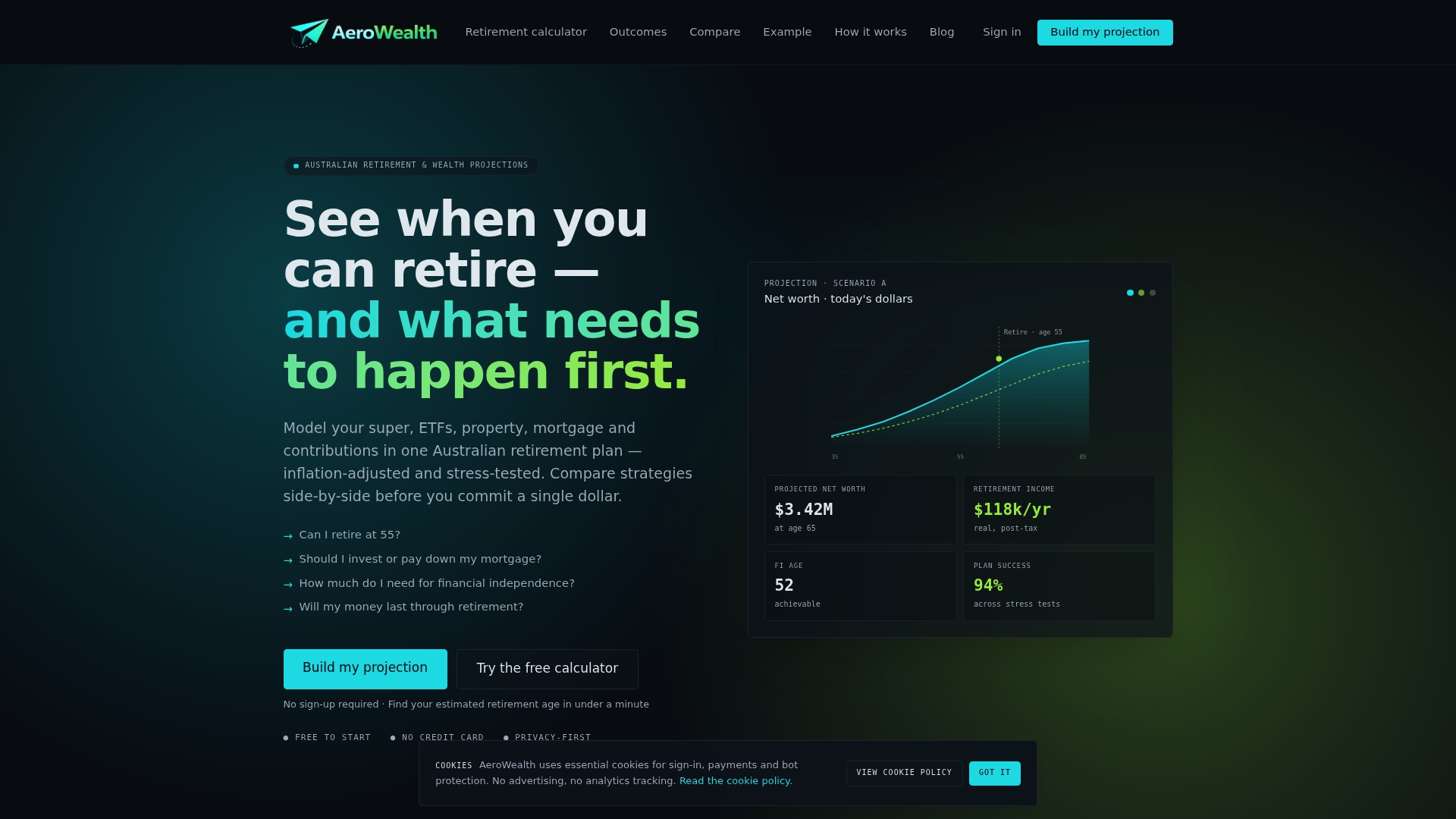
You can also open the Australian FIRE calculator with CGT and mortgage modelling to try a first scenario, or start from the AeroWealth home page.
FAQ
What is the difference between Fat FIRE and regular FIRE in Australia?
Fat FIRE targets an above-average spending level in retirement, so it needs a larger portfolio and usually a high income to build it. Regular FIRE aims for a more ordinary lifestyle, and Lean FIRE for a frugal one. In Australia, all three still face the same preservation age rules for super.
Can I retire at 45 and live off super?
Not directly. For anyone born from 1 July 1964, preservation age is 60, and early access is limited to narrow conditions of release such as medical or compassionate grounds. Retiring at 45 means funding about 15 years from assets outside super, then switching to super once you can access it.
How much do I need for Fat FIRE in Australia?
There is no official figure, because it depends on your spending. A common starting point is annual spending divided by a withdrawal rate, such as 3.5% to 4%, so $120,000 a year implies roughly $3,000,000 to $3,430,000. Adjust for tax, the bridge years and your family situation, then stress-test the result.
Is Fat FIRE with kids realistic?
Yes, but the target is higher and the timeline usually longer. Childcare, schooling and housing costs are the big movers, so model them as separate lines and compare retiring while the kids are young with retiring after they finish school. A few extra working years often lower the risk noticeably.
Will I get the Age Pension if I reach Fat FIRE?
Probably not at first. Full-pension asset limits are $333,000 for a single homeowner and $499,000 for a homeowner couple, and a Fat FIRE portfolio is usually far above them. Treat any pension as a possible later upside, and check Services Australia for current thresholds.
Sources
- When you can withdraw your super, Australian Taxation Office
- Withdrawing and using your super, Australian Taxation Office
- What happens to your super when you retire, MoneySmart
- Assets test for Age Pension, Services Australia
- New year changes for child care, social security and health costs, Services Australia
- Temporary Financial Hardship additional child care subsidy, Services Australia
- How much is enough?, Commonwealth Superannuation Corporation
- We retired early with $4m and learnt two big lessons, Infinite Wealth
- Home extension planning in Queensland: what to check first